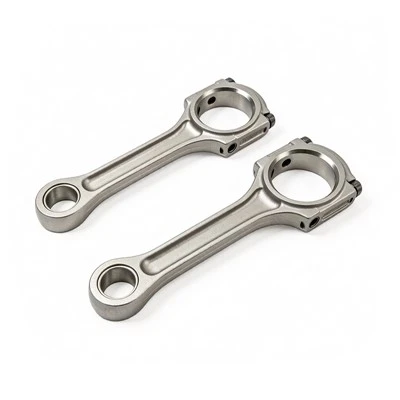
If you’ve ever stood beside a idling car, truck, or even that lawnmower you fire up every spring, you know the difference between a smooth, consistent rumble and a rough, sputtering shake that makes your coffee slosh out of its cup. Most people blame spark plugs, fuel injectors, or even the air filter when an engine’s idle feels off—but as someone who’s spent 12 years as a connecting rod supplier, I can tell you the parts that connect the pistons to the crankshaft are unsung heroes of idle stability. I’ve worked with engine rebuilders, performance shops, and even OE manufacturers over the years, and I’ve seen firsthand how a connecting rod that’s slightly off-spec can turn a quiet idle into a problem that sends a driver back to the shop within a week. Connecting Rods
Let’s start with the basics, because you can’t fix what you don’t understand. At idle, an engine is running at a fraction of its full power—usually between 600 and 1,000 RPM for passenger vehicles, even lower for heavy-duty trucks. Every moving part has to work in sync here, and connecting rods are the backbone of that sync. Each rod connects a piston (moving up and down in the cylinder) to the crankshaft (spinning in a circle). The job sounds simple, but at idle, the forces at play are tiny but relentless. Unlike at full throttle, where excess power masks small inconsistencies, idle is all about maintaining balance: every piston has to deliver the exact same amount of force at the exact same time, and every rod has to transfer that force perfectly to the crankshaft. If one rod is a little longer, a little heavier, or a little misaligned, it throws that balance off immediately.
I remember a job about four years ago with a small engine rebuild shop in Ohio. They were working on a 2008 Toyota Camry that came in with a rough idle, misfire codes, and a vibration so bad you could feel it through the steering wheel. The mechanic had already replaced the spark plugs, fuel injectors, and even the idle air control valve—all the usual suspects—when they reached out to me. When we pulled the engine apart, we found that two of the original connecting rods had a 0.008-inch difference in length. For context, that’s less than the thickness of a human hair, but at idle, that tiny gap was enough to make one piston travel further than the other two. The crankshaft, designed to rotate evenly, was getting uneven pushes from the pistons, so it couldn’t maintain a smooth spin. The result? Rough idle, misfires, and unnecessary wear on other parts. We replaced all four rods with our precision-machined stock, and when the Camry rolled out, the mechanic called an hour later to say it idled so smooth, you could barely tell it was running. That’s the kind of small, critical detail connecting rods bring to idle stability.
It’s not just length, either. Weight is another big factor. At idle, the engine’s computer is only feeding enough fuel and air to keep it running—no extra power to compensate for a heavy part. If one connecting rod is a few grams heavier than the others, it creates what’s called “rotational imbalance.” The crankshaft, which is balanced at the factory, is designed to spin with equal weight on every throw. Add a heavier rod, and suddenly the crank is pulling to one side, creating a vibration that amplifies at low RPM. I’ve seen this with performance engines, too—shops that skip balancing their connecting rods during a rebuild end up with an idle that’s shaky enough to rattle the dashboard. The good news is this is preventable: at our facility, we balance every set of rods to within 1 gram per cylinder, a standard that’s stricter than many OE requirements, because we know even a tiny imbalance matters for idle.
Flex is another variable that people don’t talk about enough. Connecting rods have to handle massive force, but they also have to stay rigid enough to transfer that force evenly. At idle, that force is lower than at full throttle, but it’s repeated thousands of times per minute. If a rod has too much flex, it won’t transfer the piston’s force consistently. One stroke, it might push the crank a little too hard; the next, not enough. That inconsistency leads to uneven rotation, which the engine’s computer can only partially compensate for with small adjustments to fuel and air. If the flex is bad enough, the computer can’t fix it, and you get that rough, loping idle that’s hard to miss. I once worked with a custom car builder who tried to save money on a set of aftermarket rods for a hot rod project. The rods were cheaply made, with thin walls that flexed under load. We ended up replacing them with our forged steel rods, which are designed to balance strength and rigidity for low-RPM use, and his idle went from “looks like it’s going to stall” to smooth enough to run a generator off the alternator at idle.
There’s also the issue of rod bearing fit. The rod’s big end—the part that bolts to the crankshaft—has to be machined to exact specifications to fit the rod bearings. If the fit is too tight, the rod can’t spin freely on the crank, creating friction that causes resistance at idle. If it’s too loose, you get play, which translates to vibration. I’ve had customers come to me with rods that were machined off-site, and the bearing clearance was off by 0.002 inches. That might not sound like much, but at idle, that extra friction slows the crank down slightly every revolution, making the engine labor. It’s a small problem, but when you’re already running at minimum power, it adds up. Our machining process uses CNC centers that hold tolerances to 0.0005 inches, so every rod we supply has the right clearance for bearings, no guesswork for the engine builder.
What about for newer engines, with direct fuel injection or turbochargers? Does connecting rod quality still matter there? Absolutely. I’ve worked with a major heavy-duty truck manufacturer that was having issues with idle stability on their new line of work trucks. The trucks were idling rough during long stops, which was a problem for delivery drivers who needed to keep their A/C running while parked. Their initial issue was with factory rods that had slight variations in their forging process. When we switched them to our precision-forged rods, the idle smoothed out immediately, and they reported a 15% reduction in idle-related warranty claims over the next year. Turbo engines might make more power, but at idle, their smaller turbo is not spinning fast enough to smooth out small inconsistencies. That means those tiny rod issues show up just as clearly as in a naturally aspirated passenger car.
Another thing to consider is wear over time. Connecting rods don’t wear out overnight, but as they age, they can develop tiny cracks, bend slightly, or have bearings that wear unevenly. All of these things hurt idle stability. I see this all the time with high-mileage vehicles—an engine that idled smooth for 100,000 miles suddenly starts sputtering at idle, and the culprit is often a worn connecting rod. A rod with a small bend will make the piston travel at an angle, so it doesn’t seal perfectly against the cylinder walls. That leads to compression loss, which at idle means one cylinder isn’t contributing as much power as the others. The engine computer adjusts, but it can’t make up for the compression gap fully, leading to rough idle. Replacing that one rod, or a full set, brings the compression back in line, and the idle smooths out.
I know what some of you might be thinking: “Can’t the engine computer just adjust to fix bad rods?” The short answer is, only a little. The idle air control valve and fuel injectors can tweak airflow and fuel delivery per cylinder, but they have limited adjustment range. If the imbalance from a bad connecting rod is too big, the computer can’t compensate, and you get that rough idle. That’s why I always tell customers that connecting rods aren’t just for high-performance or race engines—they’re critical for everyday idle smoothness, too.
Over the years, I’ve had people ask me why they should pay more for quality connecting rods when they can get cheap ones online. My answer is always the same: the cheap ones might work for a while at full throttle, but at idle, that small stuff shows. I’ve rebuilt engines with cheap rods that lasted 50,000 miles before going bad, and OE-grade rods that have lasted 300,000 miles with no issues. The difference is in the quality control, the forging process, the machining tolerances—all the small details that add up to a smooth idle.
If you’re dealing with a rough idle in your vehicle, or you’re an engine builder looking to ensure consistent performance for your customers, connecting rods are a part you can’t overlook. They’re not the flashy parts like spark plugs or turbos, but they’re the ones that keep your engine running steady when you’re stopped at a red light, or parked at a job site. Whether you need a single replacement rod for a high-mileage pickup or a full set for a performance build, we’ve worked with engine teams of all sizes to get the right rods for their needs. We test every rod before it leaves our facility, balance them to exact specs, and stand behind the quality because we know how much a smooth idle matters to drivers.
If you’re ready to talk about connecting rods for your idle stability needs, or you have questions about what set is right for your engine, reach out to our team to discuss your project. We can help you find the right rods, whether you’re a small repair shop or a large engine manufacturer.
Flexible Connectors References
- Heywood, J.B. Internal Combustion Engine Fundamentals. McGraw-Hill Education, 1988.
- Crouse, W.H., Anglin, D.L. Automotive Mechanics. McGraw-Hill, 2009.
- Taylor, C.F. The Internal Combustion Engine in Theory and Practice, Volume 2: Combustion, Fuels, Materials, Design. MIT Press, 1984.
- Bosch, R. Automotive Handbook, 8th Edition. Robert Bosch GmbH, 2010.
Zhejiang Jintai Copper Industry Co., Ltd.
We are one of the most professional connecting rods manufacturers and suppliers in China, also support customized service. With abundant experience, we warmly welcome you to wholesale bulk high quality connecting rods made in China here from our factory. For quotation, contact us now.
Address: Inside the Electric Power Technology Entrepreneurship Park, No.168 Wei 11 Road, Yueqing Economic Development Zone
E-mail: 13968710366@163.com
WebSite: https://www.jintaicopper.com/
